
Equine Science Article Highlight: Differences between facilities in horse welfare profiles
Featured article by Léa Gueguen, Rupert Palme, Patrick Jego, Séverine Henry and Martine Hausberger, (2025). Differences between facilities in horse welfare profiles. Animal 19, 101520.
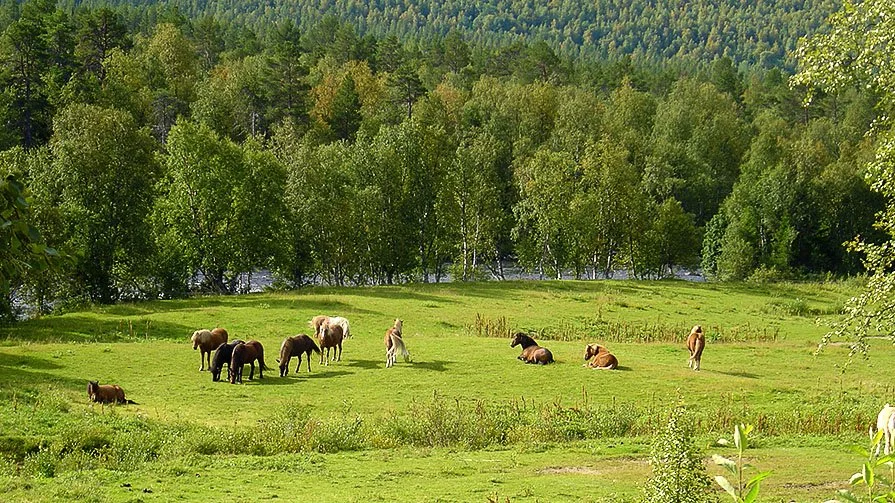
Source: www.fjallhasten.se
Research from Martine Hausberger’s ethology group in France[1] found that riding schools could be told apart by the temperament of their horses, and that changing a single management factor could shift that. In a 2025 study in Animal, Gueguen et al. asked whether the same was true of welfare. They re-analysed data collected in 2007 on 55 horses across three riding schools with almost identical housing: individual boxes, straw bedding, the same feeding routine and similar workloads. Turnout differed. One school offered two days a week, another one day, and the third only a few hours.
Welfare followed that gradient: the school with the most turnout had the healthiest, most settled horses, and the school with the least had the most back problems and signs of stress. However the authors were careful to note that the turnout differences were small, and the schools also differed in riding technique and handling, so turnout alone may not explain the gap.
Box-paddock-box: looking beyond turnout and the stable as default housing
What the study does show clearly is the welfare burden of conventional stabling. Across all three schools, nearly two-thirds of horses showed stereotypic behaviours and almost three-quarters had back problems. That was true even where turnout was most generous. Other research cited by the authors points the same way: one study found that a single hour of daily free movement over three weeks improved behavioural and some physiological welfare indicators in stabled horses (Lesimple et al., 2020).
Free movement clearly benefits horses. However, the authors note evidence that returning to a box after time outdoors can itself trigger a rebound in chronic stress, so re-stabling may undo much of what turnout provides. Paradoxically, turnout is only needed as a remedy because full-time stabling is the baseline. Remove that baseline, and the cycle of relief and confinement disappears with it.
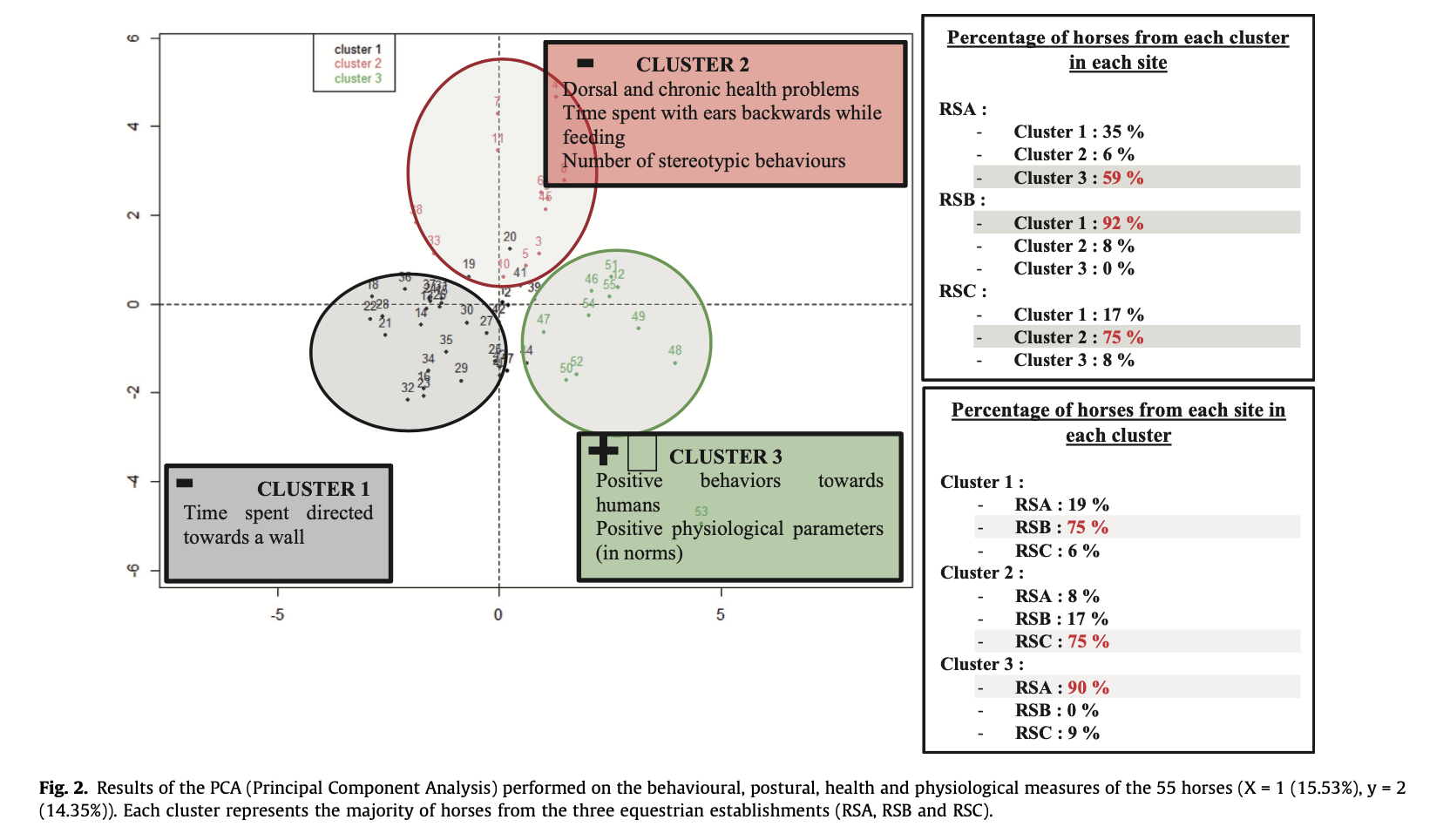
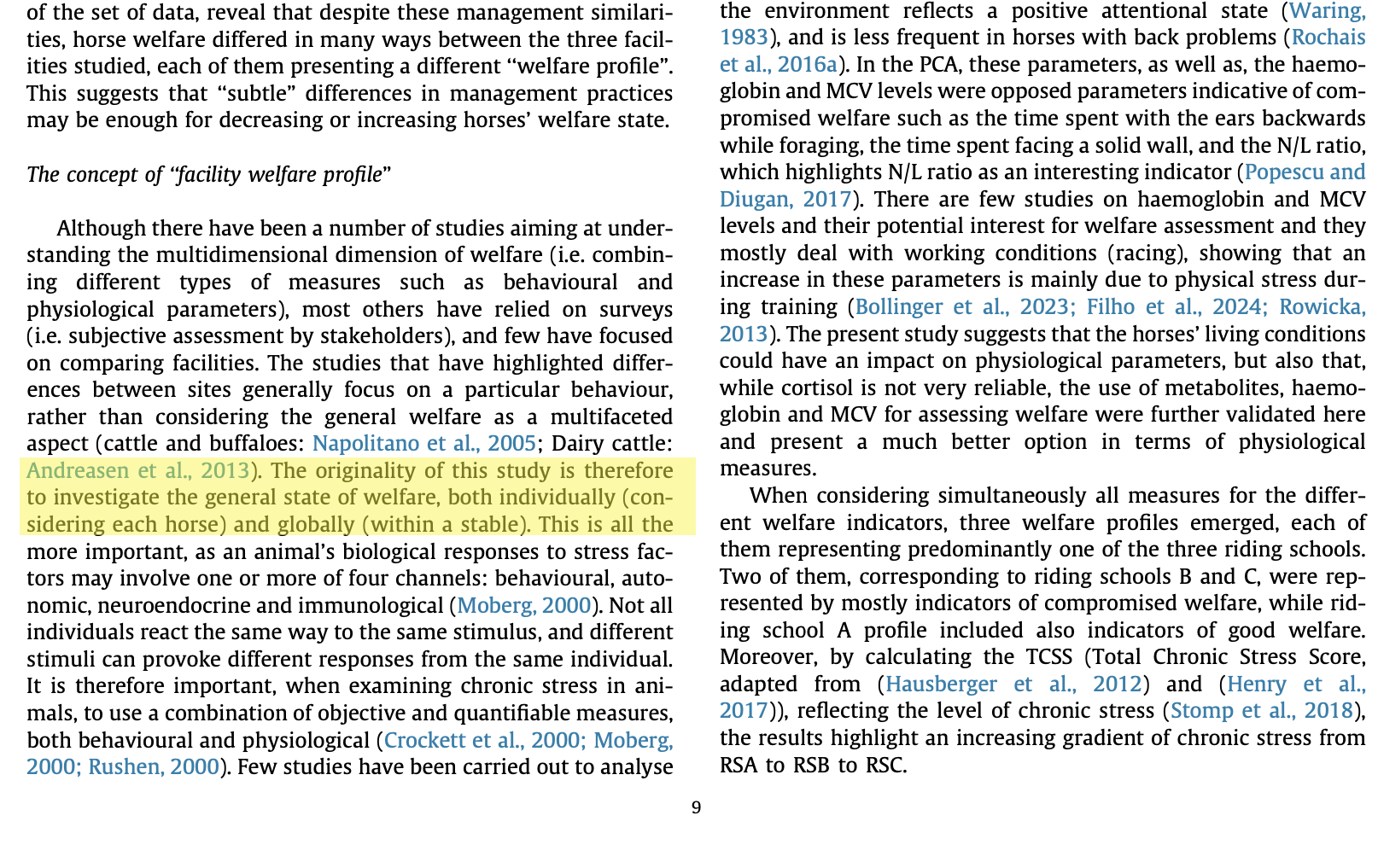
Excerpt from published article
Through the Five Domains lens, the box restricts the physical environment and behavioural interactions (movement, foraging and social contact), and both feed directly into the horse’s mental state. Turnout treats those restrictions part-time. It doesn’t remove them.
The origins of stable typology provide useful context for current management needs and changes in welfare standards. The stable as we know it was designed for horses as military assets and working transport: animals kept ready, contained and close to hand. Today’s horse is overwhelmingly a recreational companion, and that purpose calls for a different starting point.
The design question shifts from how much time out of the box? to why is confinement the default state at all?
Answering that question means designing for the horse’s behaviour rather than against it. In practice, that could mean:
stables that open directly onto a yard or paddock, so the horse chooses when to come and go, rather than a handler deciding when it goes out and how long it stays in
permeable partitions, so social contact (or retreat) is by choice rather than scheduled
feeding arrangements at ground level that allow continuous foraging in a natural head-down position, rather than set meals from feeders at an unnatural height, where the wall-mounted fixture itself can also pose an injury risk.
It is the same principle we argued for in our earlier highlight on crib-biting. There, rather than capping every edge in steel to stop the behaviour, we proposed accommodating it safely within the stable. In both cases, the built environment should work with what the horse needs to do, not suppress it.
Horses remain managed animals, and good design doesn’t remove the need for good management. But architecture can change what “normal” looks like, by designing for continuous movement, shelter by choice and social contact as the baseline, with confinement as the exception rather than the routine.
[1] Lesimple, C., Fureix, C., LeScolan, N., Richard-Yris, M.-A., Hausberger, M. (2011). Housing conditions and breed are associated with emotionality and cognitive abilities in riding school horses. Applied Animal Behaviour Science 129, 92–99. https://doi.org/10.1016/j.applanim.2010.11.005